Published: November 23, 2026
Disclaimer: This article is general information for US readers, not personal financial advice. Rates, dealer policies and surcharge laws change, so confirm anything here with the dealer, your card issuer or a qualified adviser before you act on it. Full terms are in the disclaimer.
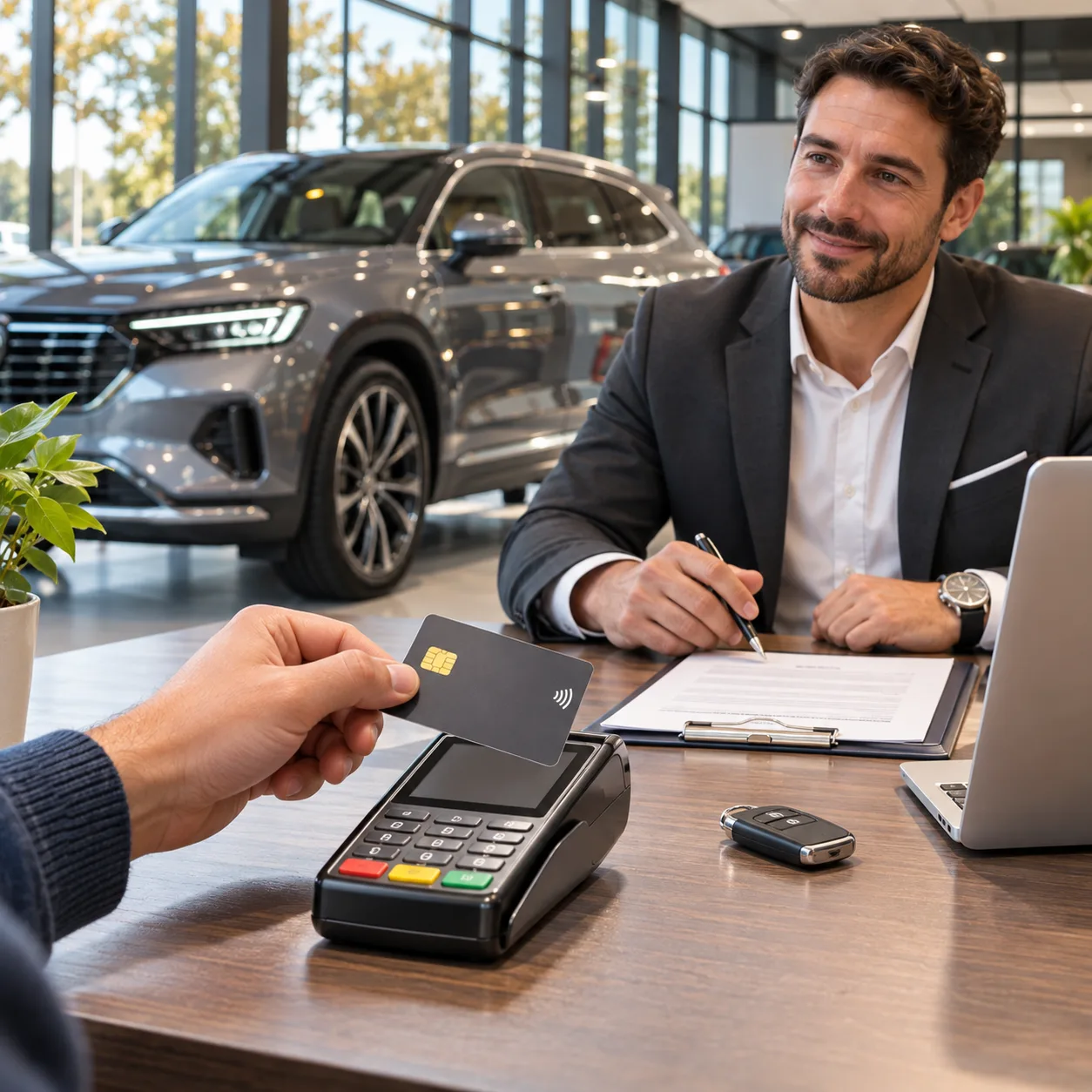
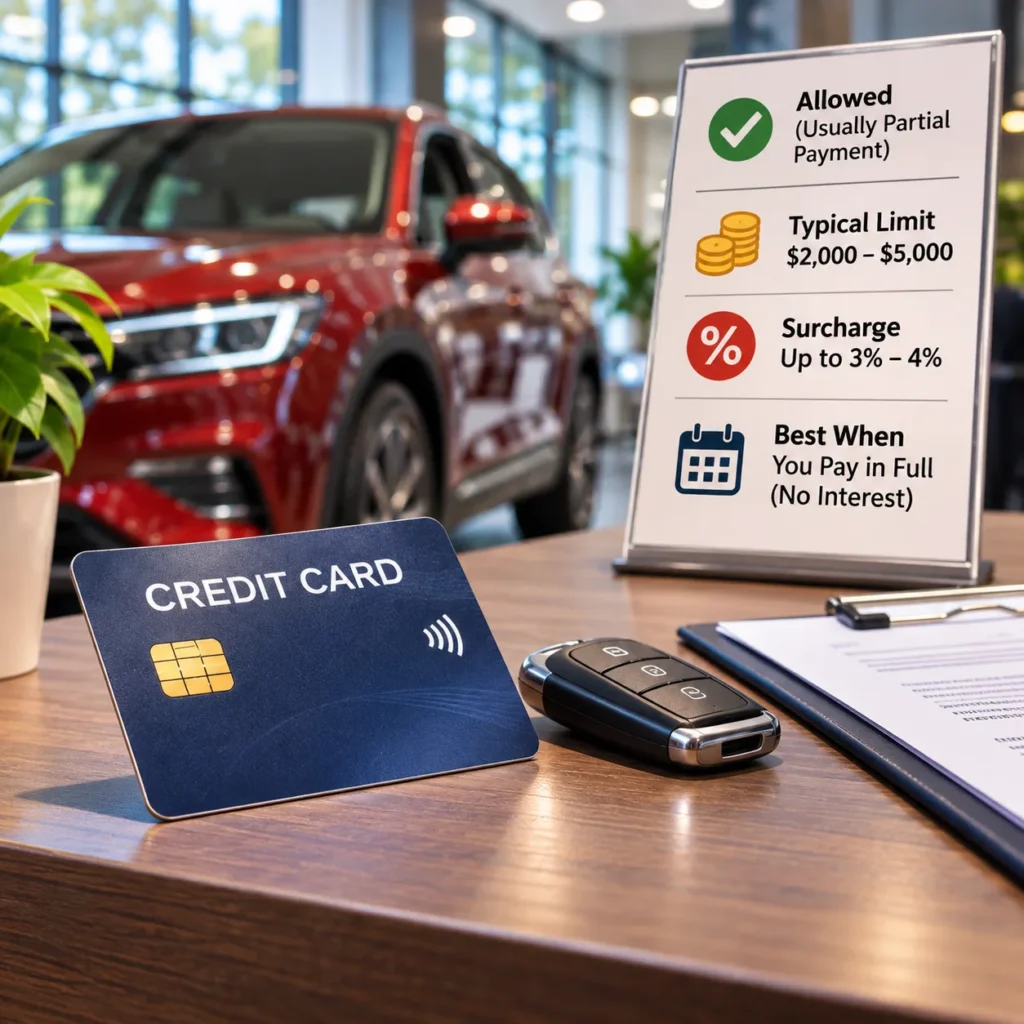
Yes, though almost never for the full price. The dealer sets the cap, not the law, and most take $2,000 to $5,000 on a card, usually toward the down payment. Some take more, and plenty of small used lots take none. Expect a surcharge on top: Visa caps it at 3% and Mastercard at 4%, while four US jurisdictions ban credit card surcharges outright. The real cost is carrying the balance, because cards that carry a balance averaged 22.36% in the Federal Reserve’s G.19 figures against 7.54% on a 60-month new car loan. Putting a car on a card pays off in one case only, when you clear the balance by the statement due date and the dealer adds no fee.
You’re at the finance desk, the paperwork is half done, and the card in your wallet needs about $4,000 more to trigger its sign-up bonus. So you ask the obvious thing: can you buy a car with a credit card and collect the points on the way out?
Rates here come from the Federal Reserve’s G.19 consumer credit release, and the dealer experiences come from active car-buying and credit card forums.
Can You Buy a Car With a Credit Card?
Yes, and no federal law stops you. What stops you is the dealer’s own policy, and that policy exists because the dealer, not you, pays for the privilege of taking plastic.
Why Dealers Limit Card Payments
Every swipe costs the seller a percentage of the sale. The Federal Reserve puts card processing costs at 1.5% to 3% of the transaction amount, a figure its staff note takes from payments industry data, with interchange fees estimated to make up 70% to 90% of that total.
Run that across a car. On a $30,000 vehicle, a 2.5% processing cost is $750 handed to the card networks and banks out of a single deal. A grocery store absorbs that kind of cut across thousands of small tickets. One car cannot.
So dealers do one of three things: refuse cards entirely, accept them only up to a fixed dollar cap, or accept a larger amount and pass the processing cost to you as a surcharge.
Dealer vs Private Seller vs Online Car Retailers
Franchised dealers: The most likely to accept a card, and the most likely to have a written cap. Ask for it before you negotiate the price.
Private sellers: Almost always a no. Someone selling a car out of their driveway has no merchant account, so there is nothing to swipe. Peer-to-peer payment apps look like a workaround, but they are built for small transfers, carry their own sending limits, and their buyer protections are written around goods bought from businesses rather than a private vehicle sale. Read the app’s own terms before you plan a $12,000 transfer around them.
Online car retailers: Each publishes its own payment rules, and most restrict cards to a deposit or a fixed portion of the price. Check the checkout page before you get attached to a car.
Card Limits and Surcharges
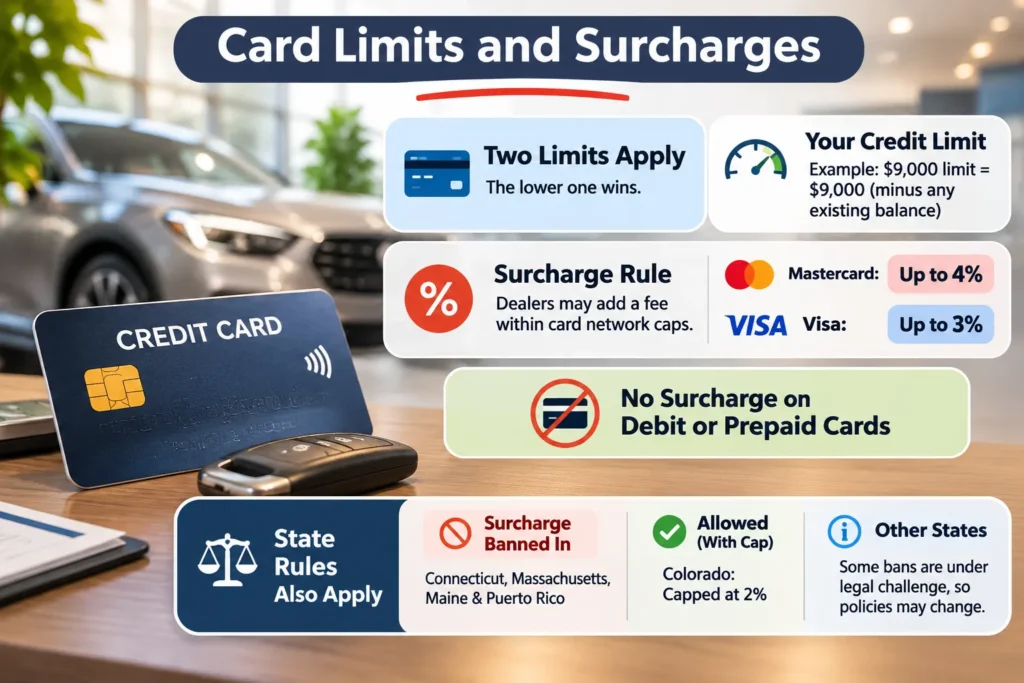
Two ceilings apply at once, and the lower one wins.
The first is your own credit limit. A $9,000 limit means $9,000, minus whatever balance you already carry.
The second is the surcharge rule. Mastercard publishes a Maximum Surcharge Cap of 4% and adds that a merchant may charge no more than its own average effective discount rate. Visa lowered its cap to 3% in April 2023. Neither network allows a surcharge on debit or prepaid cards at all, which is a detail almost nobody mentions and one that can save you a few hundred dollars.
State law applies on top of the network rules. Connecticut, Massachusetts, Maine and Puerto Rico prohibit credit card surcharges. Colorado permits them but caps them at 2%. A handful of other state bans have been challenged in court and their status keeps moving, so treat the dealer’s answer, in writing, as the one that counts.
Can You Use a Credit Card for a Down Payment on a Car?
Yes, and this is how most people actually use a card on a car. The dealer keeps the processing cost small, you still get the points, and the rest of the price goes on a loan at a far lower rate.
How Much Dealers Typically Accept
The common band is $2,000 to $5,000. The spread around it is wide. One r/CreditCards poster who bought several cars reported being allowed $1,000 at one dealer, then $4,000, $5,500 and $12,500 at three others. A buyer in r/carbuying described a straightforward $5,000 on the card, pointing out they took the points and cleared the balance the next day. A commenter in r/CreditScore ran into the opposite: a small local used lot that accepted no card at all, cash or cashier’s check only.
None of these is a rule. They are the same policy question answered four different ways by four different businesses.
So make the call before you drive over, and ask for three things in an email you can keep:
- The maximum dollar amount you can put on a card
- Whether a surcharge applies, and the exact percentage
- Whether the cap changes if you finance through the dealer rather than your own bank
Does Your Lender Care Where the Down Payment Came From?
Not in the way people fear. An auto lender is reading your credit file, not tracing your bank statement line by line, and there is no standard underwriting step that asks which card funded the cash down.
The new balance is a different story. Charge $5,000 and your card’s minimum payment climbs, which raises your debt-to-income ratio, the figure lenders get by dividing your monthly debt payments by your gross monthly income. Put the down payment on a card on Monday and apply for the loan on Tuesday and you may qualify for less, or for a worse rate, than you would have on Sunday.
The clean sequence is to get the loan approved first, then put the down payment on the card at signing.
How Much Should You Put Down?
Edmunds suggests 20% on a new car and about 10% on a used one, enough to absorb the steep first year of depreciation. On a $30,000 car that is $6,000 new or $3,000 used.
The CFPB makes the mechanical case: a bigger down payment cuts the amount you finance, and it may cut the interest rate you’re offered too.
Put down much less and you spend the first year or two owing more than the car is worth. That is the situation gap insurance is built for, and it is why Edmunds pairs a 10% down payment with that coverage rather than recommending 10% on its own.
Can You Pay Your Car Loan With a Credit Card?
Mostly no, at least not directly. Auto lenders take bank transfers, debit and checks, and the large majority decline credit cards for the monthly payment because they would be absorbing the same processing cost every month for the life of the loan.
Monthly Payments
Three indirect routes exist, and each one has a price.
Third-party bill-payment services: You pay the service by card, the service pays your lender by check or transfer. The fee runs close to 3% of each payment. On a $600 car payment that is roughly $18 a month, or about $216 a year, more than almost any rewards rate will pay back.
Cash advances: The most expensive option on the list. The Consumer Financial Protection Bureau warns that “the most common cash advance APR in reviewed agreements is 30 percent, which is charged even if the cardholder would typically not incur interest on regular purchases.” Its data spotlight on cash advance fees adds that most issuers charge the greater of $10 or 5% up front, with interest accruing from the date of the transaction. In 2022 alone, issuers collected $717 million in fees on $3.6 billion of cash advance volume.
Balance transfer checks: Usually 3% to 5% of the amount transferred, charged once. Cheaper than a cash advance, and the only one of the three that can make sense, for the reason below.
Paying Off the Whole Loan With a Card
Do the comparison before anything else. Your auto loan rate is printed on your contract. If it is around the 7.54% average and the card you’d move it to charges 22.36%, you would be tripling your interest cost to chase points.
A 0% introductory balance transfer is the one version that can work, and only on strict terms: the transfer fee has to be smaller than the interest you’d otherwise pay, and you need a written payoff schedule that clears the balance before the promotional period ends. Miss that date and the whole remaining balance starts earning the standard rate. Before you move anything, check how much of your payment is still interest at this point in the loan, because front-loaded interest is baked into how car loan interest works.
What It Really Costs: Credit Card vs Auto Loan
Here is the arithmetic on $5,000 of a car’s price, paid off over 12 months either way. Rates come from the Federal Reserve’s G.19 consumer credit release dated 6 November 2026: 22.36% on card accounts assessed interest, 7.54% on a 60-month new car loan from a commercial bank.
| Scenario | Monthly payment | Interest paid |
|---|---|---|
| Card at 22.36%, paid over 12 months | about $469 | about $626 |
| Auto loan at 7.54%, paid over 12 months | about $434 | about $207 |
| Card paid in full within the grace period, with a 3% surcharge and 2% rewards | n/a | $0 interest, but the $150 fee outweighs the $100 in rewards |
Illustrative example. Your own rate will differ by credit profile, lender and term.
Two numbers do all the work here.
Carry the balance for a single year and the card costs about $419 more than the loan on the same $5,000. That is the entire argument against financing a car on plastic, in one figure.
Pay in full and interest drops to zero, but the surcharge does not. A 3% fee on $5,000 is $150. A 2% rewards card gives back $100. You are $50 down for the trouble.
Which produces the only rule you need: rewards win only when the surcharge is smaller than your rewards rate, and the balance is gone by the due date. A 3% surcharge always costs more than a 2% rewards card pays back. A dealer who charges nothing reverses that, every time.
How Buying a Car With a Credit Card Affects Your Credit Score

A large car charge touches three parts of your score at once, and the damage is temporary if you pay it off quickly.
Credit utilization: The biggest effect, and the fastest. FICO counts amounts owed as 30% of your score, second only to payment history at 35%. Put $5,000 on a card with a $10,000 limit and your utilization on that card jumps to 50% overnight. Scores usually recover within a billing cycle or two of paying it down, because utilization is recalculated from your current balance rather than averaged over time.
A new hard inquiry: Opening a card for the purchase adds an inquiry and drops your average account age. Both effects are small on their own and both fade.
Payment history: The part you cannot undo. Carry the balance, miss a due date, and a late payment stays on your report for seven years.
Timing: Avoid all of this in the three to six months before a mortgage application. With a deadline that close, spend the months on how to improve credit score fast.
When Using a Credit Card for a Car Can Make Sense
Four conditions, and you need every one of them.
- You can clear the full balance by the statement due date. Not “soon”, not “within a few months”. By the date printed on the statement.
- The dealer charges no surcharge. If there is one, compare it against your rewards rate before you agree.
- You have a 0% introductory APR and a written payoff plan that finishes before the promotion does. Divide the balance by the number of promotional months and check that figure against your actual budget.
- The charge earns a sign-up bonus you were going to hit anyway. Spending more than you planned to reach a bonus is how the bonus ends up costing more than it pays.
One benefit you should not count on: purchase protection and extended warranty coverage. Card benefit guides routinely exclude motor vehicles, and American Express states the exclusion plainly in its own purchase protection guide, so the protection argument that works for a laptop does not carry over to a car.
When to Avoid It
Any one of these is enough to put the card away.
- You’d carry the balance at a typical card rate. At 22.36% on accounts assessed interest against 7.54%, the loan wins and it is not close.
- The transaction would code as a cash advance. Roughly 30% APR, a fee of $10 or 5% whichever is larger, and interest from day one.
- The dealer adds a surcharge bigger than your rewards rate. You are paying for the privilege of earning less than you spend.
- You’re applying for a mortgage or another loan soon. A sudden utilization spike is the last thing an underwriter wants to see.
- You’re already carrying card debt. Adding a car to it compounds the problem, and the first job is clearing it, which starts with how to pay off credit card debt faster.
How to Buy a Car With a Credit Card, Step by Step
- Call the dealer first. Ask for the card cap and any surcharge percentage, and ask them to confirm both by email. Policies vary by store even inside the same brand, and the salesperson you speak to on the lot may not know the finance office’s rule.
- Check your own credit limit, then warn your issuer. A $5,000 charge at a car dealership is exactly the pattern fraud systems decline. One call or in-app note beforehand prevents a declined card in front of a finance manager.
- Pay part on the card and the rest another way. The common structure is card for the down payment, then a cashier’s check, bank transfer or approved loan for the balance. If you’re bringing cash alongside the card, note that the IRS requires dealers to report cash receipts over $10,000 on Form 8300 within 15 days. On a car priced over $10,000, a cashier’s check or money order with a face value of $10,000 or less counts as cash too, because the IRS treats that sale as a designated reporting transaction. It is routine paperwork, nothing more, but it surprises people at the desk.
- Keep everything. The buyer’s order, the card receipt showing the surcharge as a separate line, and the email confirming the cap. Network rules require that surcharge to appear separately on your receipt.
- Pay the balance off fast. Ideally before the statement closes, so the high balance never reaches the credit bureaus at all.
Alternatives to Paying With a Credit Card
- An auto loan from a bank or credit union. Get pre-approved before you visit. The FTC advises lining up your own financing first and asking for the out-the-door price in writing before any financing conversation starts.
- A personal loan. Averaging 11.90% on a 24-month term in the same G.19 release. Higher than an auto loan, well under a card, and useful when the car is too old for standard auto financing.
- A cashier’s check, bank transfer or debit card. Debit deserves a second look here: card networks prohibit surcharges on debit entirely, so a dealer that charges 3% on credit charges nothing on the same amount paid by debit. Check your daily debit limit with your bank first, as it is often well below a car’s price.
- Saving for a bigger down payment. Less exciting, and it beats every option above on total cost.
The Bottom Line
Yes, you can buy a car with a credit card, and in practice you’ll be paying for part of it rather than all of it. The card only wins when you dodge both costs: no surcharge from the dealer, and no balance left after the statement due date. Miss either one and an auto loan is cheaper, by about $419 on every $5,000 over a year. Call the dealer, get the cap and the fee in writing, and compare the two before you sign anything.
Frequently Asked Questions
Q1: Can You Buy a $10,000 Car With a Credit Card?
A: Sometimes, though you’d be at the top end of what dealers allow. Most cap card payments between $2,000 and $5,000, so a $10,000 charge usually needs a dealer that accepts larger amounts and passes its processing cost to you as a surcharge. Confirm the cap and the fee in writing before you negotiate the price.
Q2: Can I Buy a $5,000 Car With a Credit Card?
A: Often yes, since $5,000 falls inside the typical dealer cap. The bigger question is the seller. A franchised dealer is likely to accept it, a small independent lot may not, and a private seller almost certainly cannot. Call ahead, and check your available credit covers the full amount plus any surcharge.
Q3: How Much Can You Put on a Credit Card to Buy a Car?
A: Whichever is lower: the dealer’s cap or your remaining credit limit. Dealer caps commonly fall between $2,000 and $5,000. There is no federal limit and no “$3,000 rule” despite the phrase circulating online; that is a savings rule of thumb, not a regulation. The only real federal threshold is the IRS $10,000 cash reporting requirement, which applies to cash, not cards.
Q4: Can You Buy a Car With a Debit Card?
A: Usually yes, and it avoids the surcharge entirely, because card network rules prohibit surcharging debit and prepaid cards. The catch is your bank’s daily purchase limit, which is often a few thousand dollars and well below a car’s price. Call your bank to raise it temporarily, or use a cashier’s check instead.
Q5: Can You Buy a Used Car With a Credit Card?
A: At a used car dealership, often yes, under the same caps and surcharge rules as a new car. From a private seller, almost never, since they have no way to process a card payment. Small independent lots are the least likely to accept cards of any kind.
Q6: Do Dealers Charge a Fee for Paying by Credit Card?
A: Many do. The surcharge covers the processing cost the dealer pays, which a Federal Reserve staff note puts at 1.5% to 3% of the transaction, citing payments industry data. Mastercard caps surcharges at 4% and Visa at 3%, and Connecticut, Massachusetts, Maine and Puerto Rico ban them outright. The fee must appear as a separate line on your receipt.
Q7: Does Buying a Car With a Credit Card Hurt Your Credit?
A: Temporarily, yes. A large charge raises your credit utilization, which FICO counts as part of the 30% “amounts owed” category, and the drop can be steep until you pay it down. Opening a new card adds a hard inquiry too. Both recover quickly. A missed payment does not.
Q8: Can You Earn Rewards on a Car Purchase?
A: Yes, when the dealer treats it as a normal purchase rather than a cash advance. The arithmetic decides whether it is any good: a 3% surcharge on a 2% rewards card leaves you down 1% of whatever you charged. Rewards only come out ahead when the dealer adds no fee and you clear the balance in full.
Q9: What’s the Smartest Way to Pay for a Car?
A: Compare the total cost of each route rather than the monthly payment. Cash costs nothing in interest but uses your savings. A pre-approved auto loan from a bank or credit union gives you a rate to negotiate against. A card makes sense for a fee-free portion you’ll clear immediately. Get financing quotes before you visit the dealer.
Q10: How Much Would a $30,000 Car Payment Be a Month?
A: About $602 a month at 7.54% over 60 months with no down payment, totalling roughly $36,100. Illustrative only, using the commercial bank average from the Federal Reserve’s G.19 release; your rate depends on your credit. A $6,000 down payment cuts it to about $482. Early payments barely dent the balance because of how car loan interest works.