Published: October 8, 2026
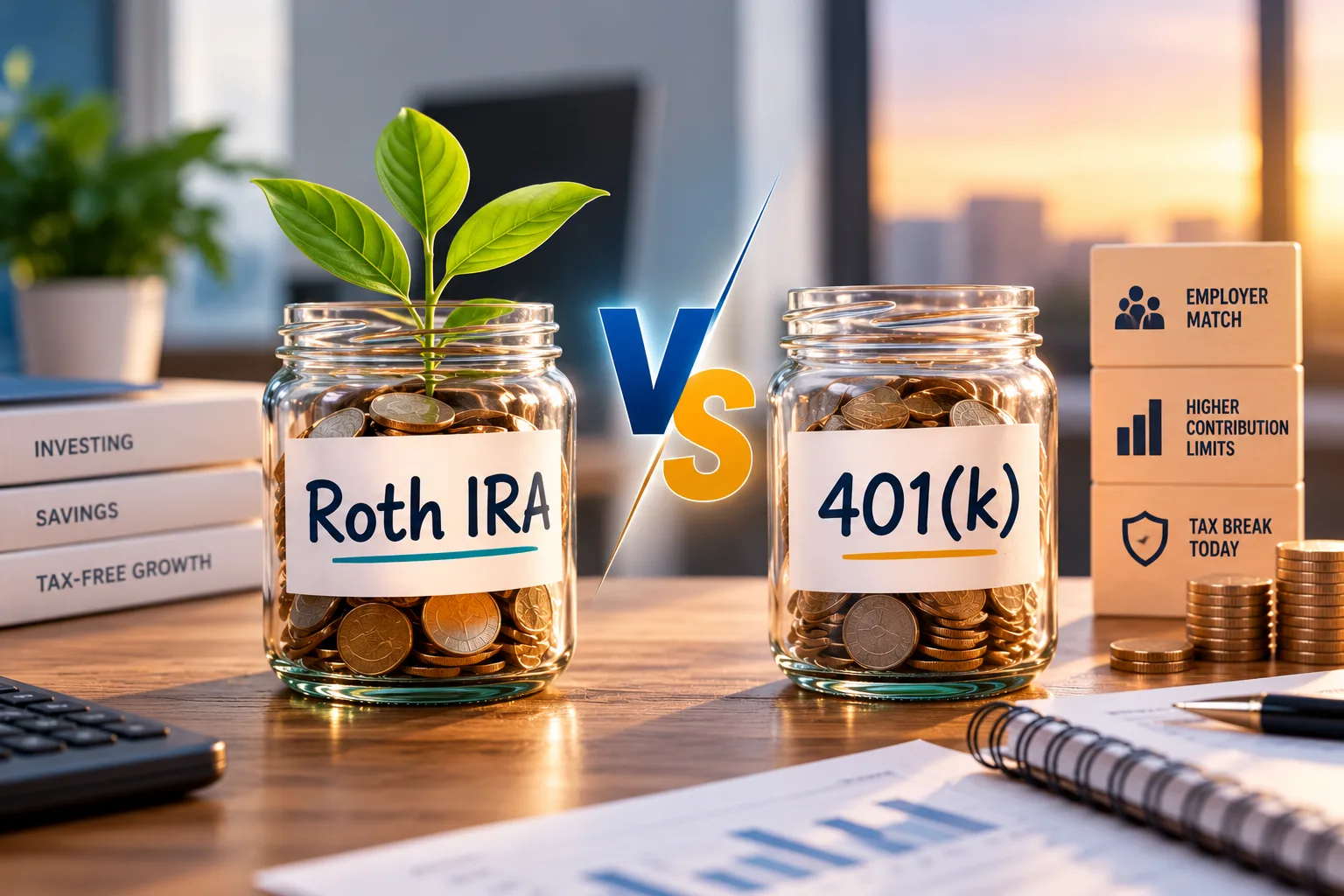
For most people, the best answer in the Roth IRA vs 401k debate is to use both, in a specific order: put enough into your 401k to collect the full employer match, then fund a Roth IRA, then go back and add more to the 401k if you still have money to save. The real difference between the two comes down to when you pay tax.
A traditional 401k gives you a tax break today and taxes you in retirement, while a Roth IRA taxes you today and lets you withdraw everything tax-free later. Which one deserves more of your money depends on your tax bracket now versus what you expect it to be later, whether your employer matches, and how much flexibility you want. Below we break down every rule that matters for 2026, run the numbers, and show you how to decide.
Quick note: This guide covers US retirement accounts and uses IRS figures for 2026. It’s general information, not personalized tax or investment advice.
What Is the Difference Between a Roth IRA and a 401k?
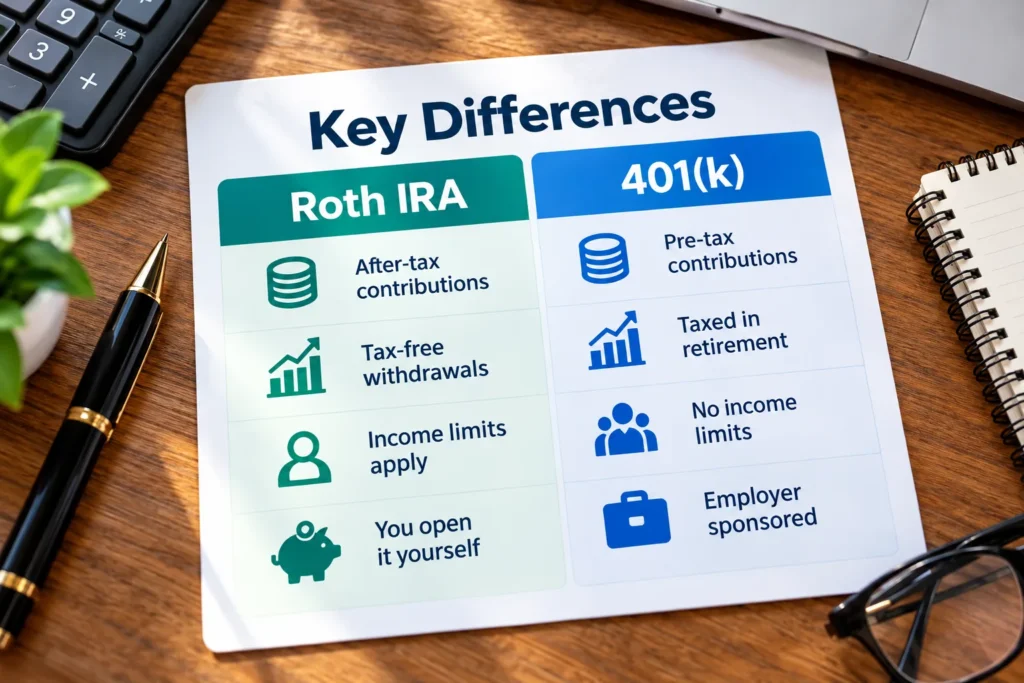
A 401k is a workplace retirement plan. Your employer sets it up, picks the investment menu, and you contribute straight from your paycheck. A Roth IRA is an individual account you open yourself at a brokerage, with no employer involved.
The bigger split is tax treatment. A traditional 401k takes contributions before income tax, so every dollar you put in lowers your taxable income this year. You pay ordinary income tax when you pull the money out in retirement. A Roth IRA works the other way around. You contribute money you’ve already paid tax on, and qualified withdrawals (after age 59½, once the account has been open at least five years) come out completely tax-free, growth included.
Many employers now offer a Roth 401k option too, which mixes the two ideas: workplace plan, Roth tax treatment. We cover how that compares further down.
Roth IRA vs 401k at a Glance
| Feature | Roth IRA | Traditional 401k |
|---|---|---|
| Who opens it | You, at any brokerage | Your employer |
| 2026 contribution limit | $7,500 | $24,500 |
| Catch-up (age 50+) | +$1,100 | +$8,000 (+$11,250 at ages 60 to 63) |
| Tax break | Tax-free withdrawals later | Tax deduction now |
| Income limit to contribute | Yes (phase-out starts at $153,000 single / $242,000 joint) | None |
| Employer match | No | Often |
| Investment choices | Almost any stock, ETF, or fund | Limited plan menu |
| Early access | Contributions anytime, tax and penalty-free | Generally 10% penalty before 59½ (some exceptions) |
| Required minimum distributions | None for the original owner | Yes, starting at age 73 |
All limits come from the IRS announcement of 2026 contribution limits. The IRS also keeps a handy Roth comparison chart if you want the official side-by-side.
Is a Roth IRA Better Than a 401k?
Not automatically. Each account wins in different situations, and the biggest factor is a simple tax question: will your tax rate be higher now or in retirement?
Here’s an example that makes it click. Say you’re in the 22% bracket and you’re willing to give up $5,850 of take-home pay this year for retirement.
- Traditional 401k: Because contributions are pre-tax, $5,850 of take-home pay lets you contribute $7,500. If that money grows four times over the next few decades, you’ll have $30,000.
- Roth IRA: You contribute the $5,850 after tax. Grown four times, that’s $23,400, and you keep all of it.
Now look at what happens at withdrawal:
- Retire in the same 22% bracket, and the 401k’s $30,000 becomes $23,400 after tax. Exactly a tie.
- Retire in the 12% bracket, and the 401k leaves you $26,400. The traditional 401k wins.
- Retire in the 24% bracket, and the 401k leaves you $22,800. The Roth wins.
That’s the whole game in one example. The math only tips one way when your tax rate changes. So a Roth tends to make more sense when you’re early in your career or in a low bracket, and a traditional 401k tends to make more sense during your peak earning years.
There’s a second, less obvious advantage to the Roth. Because the $7,500 limit applies to dollars, and Roth dollars are after-tax, a maxed-out Roth IRA effectively shelters more money than a maxed-out traditional IRA. If you can afford to max out the account, Roth gives you more room.
When a Roth IRA Usually Wins
- You’re in the 10%, 12%, or low 22% bracket today.
- You expect your income (and tax rate) to rise.
- You want the option to get at your contributions before retirement.
- You want tax-free income in retirement so withdrawals don’t push up taxes on Social Security or Medicare premiums.
When a 401k Usually Wins
- Your employer offers a match (this beats everything else, see below).
- You earn too much to contribute to a Roth IRA directly.
- You’re in a high bracket now and expect to be in a lower one when you retire.
- You want to save more than $7,500 a year.
Why the Employer Match Changes Everything
If your employer matches 401k contributions, that match is the best return you’ll find anywhere. A common formula is 50 cents for every dollar you contribute, up to 6% of your salary. On a $60,000 salary, putting in $3,600 earns you an extra $1,800 from your employer. That’s an instant 50% return before your investments do anything at all.
No Roth IRA can compete with free money. So whatever you decide about Roth versus traditional, contribute at least enough to your 401k to collect the full match first. Check your plan’s vesting schedule too, since some employers make you stay a certain number of years before the matched dollars are fully yours.
Should I Have a Roth IRA and a 401k?
Yes, if you can. You’re allowed to contribute to both in the same year, and having a 401k at work does not stop you from funding a Roth IRA. The only thing that limits Roth IRA eligibility is your income.
Using both also gives you something financial planners call tax diversification. Retirement is decades away, and nobody knows what tax rates will look like then. With money in pre-tax and Roth buckets, you can choose which account to draw from each year to keep your tax bill low.
A sensible order for most people looks like this:
- Contribute to your 401k up to the full employer match.
- Fund a Roth IRA, up to $7,500 in 2026 ($8,600 if you’re 50 or older), as long as your income allows it.
- Go back to your 401k and raise your contribution toward the $24,500 limit.
- Once those are covered, look at an HSA (if you have a high-deductible health plan) or a regular taxable brokerage account.
Before step one, it’s worth having a small emergency fund and clearing high-interest credit card debt, since paying 20%+ interest wipes out investment gains. If debt has dragged down your score, our guide on how to improve your credit score walks through the fixes.
Contribution and Income Limits for 2026
401k Limits
You can defer up to $24,500 of salary into a 401k in 2026. Workers 50 and older can add an $8,000 catch-up, for $32,500 total. If you’re between 60 and 63, the catch-up rises to $11,250 under SECURE 2.0. Employer contributions don’t count against your $24,500.
One new wrinkle for 2026: if you earned more than $150,000 in FICA wages from your employer the year before, your catch-up contributions generally have to go in as Roth money. Your plan administrator handles this, but it’s worth knowing why your catch-up shows up as Roth on your statement.
Roth IRA Limits
The Roth IRA limit is $7,500 for 2026, plus a $1,100 catch-up at 50 and older. You can’t contribute more than your earned income for the year.
The income cap is the bigger hurdle. For 2026, your ability to contribute phases out between:
- $153,000 and $168,000 of modified adjusted gross income (single or head of household)
- $242,000 and $252,000 (married filing jointly)
Above those ranges, you can’t contribute directly. Many high earners use a “backdoor Roth” instead: contribute to a traditional IRA, then convert it to a Roth. It’s legal, but the pro-rata rule can create a surprise tax bill if you have other pre-tax IRA money, so run it by a tax professional first.
Withdrawals, Early Access, and RMDs

This is where the Roth IRA pulls ahead on flexibility.
Roth IRA: You can take out your original contributions at any time, for any reason, without tax or penalty. Only the earnings are locked up.
Pull earnings out before 59½ (or before the account is five years old) and you’ll generally owe income tax plus a 10% penalty on those earnings, though some exceptions, like a first-time home purchase (up to $10,000), can remove the penalty. The Roth IRA also has no required minimum distributions during your lifetime, so it can keep growing as long as you like.
401k: Withdrawals before 59½ usually cost you income tax plus a 10% penalty. There are exceptions, including the “rule of 55,” which lets you take penalty-free withdrawals from your current employer’s plan if you leave that job in or after the year you turn 55. Many plans also allow loans. Traditional 401k money is subject to required minimum distributions starting at age 73, which forces taxable withdrawals whether you need the cash or not.
Please don’t treat a Roth IRA as an emergency fund, though. Every dollar you withdraw is a dollar that stops compounding, and you can’t put it back beyond the yearly limit.
Investment Choices and Fees
A 401k gives you whatever menu your employer picked, often 15 to 30 funds. Some plans are excellent, with low-cost index funds. Others are stuck with expensive actively managed funds and extra administrative fees.
A Roth IRA lets you invest in almost anything a brokerage offers: individual stocks, ETFs, index funds, bonds, and more. If your 401k menu is weak, that’s one more reason to fill your Roth IRA after grabbing the match.
Roth 401k vs Roth IRA: What About the Roth Option at Work?
If your employer offers a Roth 401k, you get Roth tax treatment (pay tax now, withdraw tax-free later) inside your workplace plan. It differs from a Roth IRA in a few important ways:
- Higher limit: The Roth 401k shares the $24,500 limit with your traditional 401k, more than three times the Roth IRA limit.
- No income cap: High earners locked out of a Roth IRA can still use a Roth 401k.
- Employer match: Matches can go into your account either way. Many employers still deposit them as pre-tax money, though SECURE 2.0 now allows plans to offer Roth matches.
- Early access: You can’t pull out Roth 401k contributions anytime the way you can with a Roth IRA.
- RMDs: Since 2024, Roth 401k accounts no longer have required minimum distributions, which removed one of the old reasons to roll them into a Roth IRA.
If you’re a high earner who wants Roth money, the Roth 401k is often the easiest route. If you’re under the income limits, the Roth IRA wins on flexibility and investment choice.
FAQs
Q1: Is a Roth IRA better than a 401k?
A: Neither is better for everyone. A Roth IRA usually makes more sense in a lower tax bracket and if you value flexibility. A traditional 401k usually wins in a high bracket or when your employer matches. Most people do best using both, starting with the 401k match.
Q2: Can I contribute to a Roth IRA if I have a 401k at work?
A: Yes. A workplace plan doesn’t affect Roth IRA eligibility. Only your income does. For 2026, contributions phase out between $153,000 and $168,000 for single filers and $242,000 to $252,000 for married couples filing jointly.
Q3: What are the disadvantages of a Roth IRA?
A: You get no tax deduction today, the $7,500 limit is low compared with a 401k, high earners can’t contribute directly, and there’s no employer match. Earnings withdrawn early can also be taxed and penalized.
Q4: What happens if I put $2,000 in a Roth IRA?
A: That $2,000 gets invested however you choose, and any growth is tax-free if you follow the withdrawal rules. As a hypothetical, $2,000 growing 7% a year would reach roughly $15,200 in 30 years. Actual returns vary, and you could lose money.
Q5: Can I roll my 401k into a Roth IRA?
A: Yes, usually after you leave your employer. Rolling a Roth 401k into a Roth IRA is tax-free. Rolling a traditional 401k into a Roth IRA counts as a Roth conversion, so you’ll owe income tax on the amount converted that year.
Q6: Should I stop contributing to my 401k to fund a Roth IRA?
A: Not below the match. Never give up free employer money. Above the match, shifting dollars to a Roth IRA is a reasonable move if your income qualifies and your 401k investment options are poor or expensive.
Disclaimer: This article is for general information only and is not personalized financial, investment, tax, or legal advice. Tax rules and contribution limits change every year and depend on your situation, and investing involves risk, including loss of principal. Verify current details with the IRS and consult a qualified professional before making money decisions.
Conclusion
The Roth IRA vs 401k question has a practical answer for most savers: you don’t have to choose just one. Grab your full employer match in the 401k first, fill a Roth IRA next if your income allows it, then direct any extra savings back into the 401k.
If you expect your tax rate to rise, tilt toward Roth money. If you’re in your peak earning years, the traditional 401k’s upfront deduction is hard to beat. Whichever account you favor, the habit of contributing every year matters far more than picking the “perfect” one. For more practical money guides, browse the latest posts on Da Finance Blog.


8 comments
[…] short for decentralized finance, is a system of financial services such as lending, borrowing, trading, and earning interest that runs on blockchain networks instead […]
[…] inside a Roth IRA or 401(k), you can avoid these yearly tax headaches altogether. Our guide on Roth IRA vs 401(k) for retirement explains how those accounts […]
[…] unless a tax treaty lowers it. If you’re weighing account types for the future, our Roth IRA vs 401(k) breakdown is a good place to […]
[…] full death benefit of any life insurance policy the person owned. If you’ve been weighing a Roth IRA vs 401k for retirement, it’s worth knowing that both count in full here. Foreign accounts count too, […]
[…] here. If you’re self-employed and also putting money into a solo 401(k) or IRA, our guide to Roth IRA vs 401(k) explains how those contributions change your tax […]
[…] One more thing: reporting isn’t the same as taxing. Interest and dividends earned abroad are taxable in the US regardless of these forms, and they go on your return the same way domestic income does. Foreign retirement accounts are their own tangle too, and they rarely get the tax breaks you’d get from US accounts like the ones in our Roth IRA vs 401(k) guide. […]
[…] slice of a broader plan, with retirement savings in regular accounts like the ones covered in our Roth IRA vs 401(k) comparison, makes “too good to be true” offers much easier to […]
[…] is the goal, maxing out US accounts where you still qualify can sidestep the whole issue, as our Roth IRA vs 401(k) comparison […]