

Published: October 29, 2026
Disclaimer: This article is for educational purposes only and does not constitute personalized financial, investment, tax, or legal advice. Consult a qualified financial professional before making investment decisions.
Investing is the process of putting money into assets such as stocks, bonds, mutual funds, ETFs, or real estate to potentially earn income or grow wealth over time. All investments involve some level of risk, and returns are not guaranteed.
Understanding what investing is and how it works is an important part of building long-term financial stability. Whether you want to prepare for retirement, save for a home, generate additional income, or grow your wealth, understanding how investments work can help you make informed financial decisions.
Many beginners have questions about where to start, which assets to choose, and how much money they need. The good news is that investing does not have to be complicated when you understand the basics. From stocks and bonds to mutual funds and real estate, different investment options offer different opportunities and risks.
Learning about dividends, passive investing, and diversification can also help you develop a more informed approach. By understanding important investment concepts and evaluating your financial goals, you can make decisions that better suit your circumstances.
What Are the Common Types of Investments?
Investors can choose from several types of assets depending on their financial goals, time horizons, and risk tolerance. Each investment has different characteristics, potential returns, and risks.
1. Stocks
Stocks represent fractional ownership in publicly traded companies. When you purchase a stock, you acquire an ownership interest in that business.
Investors may earn returns when a stock’s price increases or when the company distributes dividends. However, stock prices can fluctuate because of company performance, economic conditions, interest rates, and investor sentiment.
For example, an investor who purchases shares in a growing technology company may benefit if the business performs well. If the company struggles, its share price may decline.
Key takeaway: Stocks offer growth potential but can experience significant price fluctuations and losses.
2. Bonds
Bonds are debt instruments through which investors lend money to governments, municipalities, or companies.
In return, a bond may pay interest and return its principal at maturity, depending on its terms and the issuer’s ability to meet its obligations.
Bonds are often considered less volatile than stocks, but they are not risk-free. Investors may face credit risk, interest-rate risk, and inflation risk.
For example, when market interest rates rise, the market value of an existing fixed-rate bond may fall.
Key takeaway: Bonds can provide interest income and portfolio diversification, but their risks depend on factors such as the issuer’s creditworthiness and prevailing interest rates.
3. Mutual Funds and Exchange-Traded Funds
Mutual funds and exchange-traded funds (ETFs) pool money from multiple investors to purchase a collection of assets.
A fund may invest in stocks, bonds, or a combination of investments. Some funds track a market index, while others follow actively managed strategies.
One major advantage is diversification. Instead of purchasing shares in just one company, investors can gain exposure to multiple companies through a single fund.
However, diversification does not eliminate market risk. A fund can still lose value when its underlying investments decline.
Before choosing a fund, review its investment strategy, fees, holdings, and historical performance.
Key takeaway: Mutual funds and ETFs can make diversification easier, but their returns are not guaranteed.
4. Real Estate
Real estate investing involves purchasing property or investing in real estate-related assets with the goal of generating income or benefiting from appreciation.
Investors may earn rental income from residential or commercial properties. They may also benefit if a property’s market value increases.
However, direct property ownership can require substantial capital and involve maintenance, insurance, taxes, vacancies, and financing costs.
Real estate investment trusts (REITs) offer another option. These companies own or finance income-producing real estate, allowing investors to gain property-related exposure without directly managing a building.
Key takeaway: Real estate can provide income and potential appreciation, but property investments involve financial, market, and liquidity risks.
5. Commodities and Tangible Assets
Commodities include physical resources such as gold, oil, agricultural products, and other raw materials.
Some investors purchase gold or other tangible assets to diversify their portfolios or respond to changing economic conditions.
However, commodity prices can be volatile. Physical assets may also involve storage expenses, insurance, transaction costs, and liquidity challenges.
Key takeaway: Commodities and tangible assets can provide additional diversification, but their prices may fluctuate considerably.
What Is the Difference Between Saving and Investing?
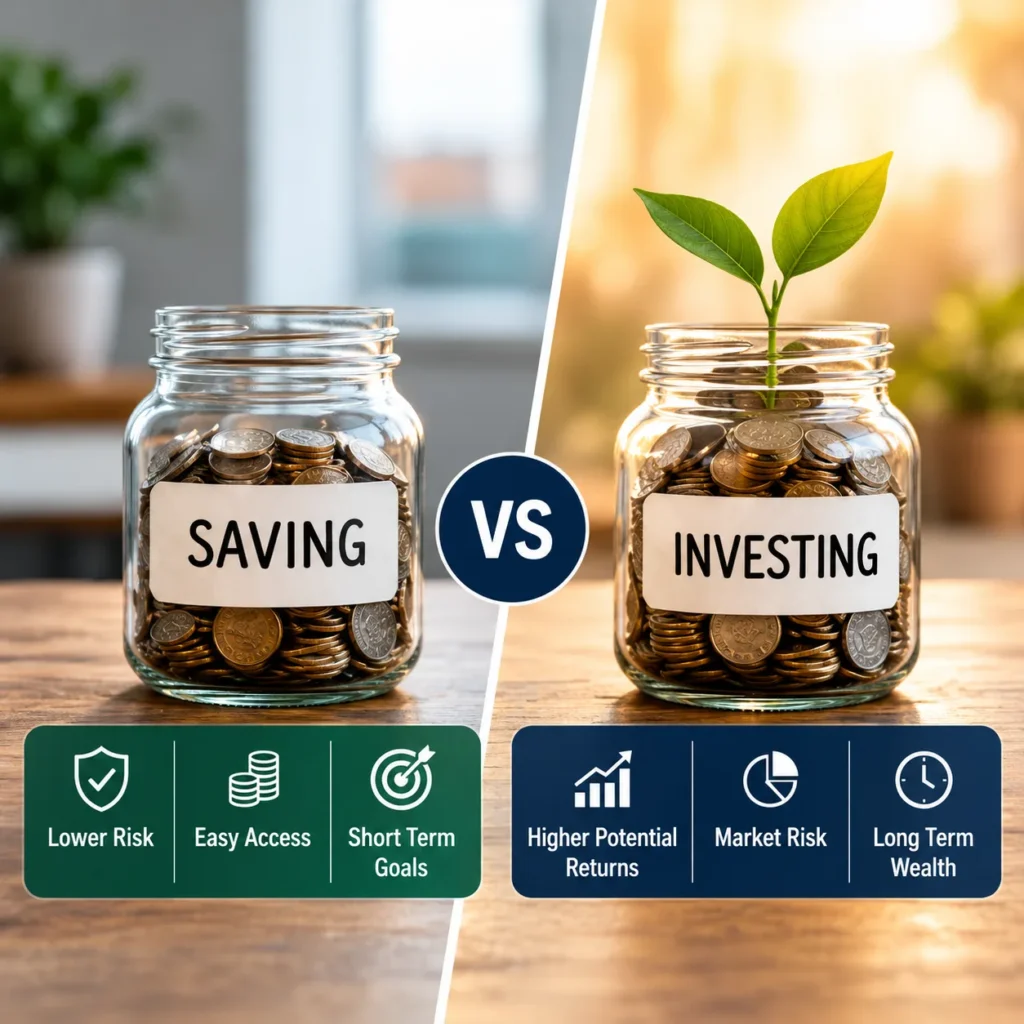
Saving and investing both help people prepare for future financial needs, but they serve different purposes.
Saving means setting aside money in relatively accessible accounts, such as bank savings accounts, high-yield savings accounts, or certificates of deposit (CDs). These options may be suitable for emergencies and short-term financial goals, depending on their terms and applicable protections.
Investing means putting money into assets whose values can rise or fall, such as stocks, bonds, mutual funds, and real estate investments. It is commonly used to pursue long-term financial goals.
Consider the following comparison:
| Feature | Saving | Investing |
|---|---|---|
| Primary purpose | Protect money and maintain accessibility | Pursue potential growth or income |
| Common options | Savings accounts, high-yield savings accounts, CDs | Stocks, bonds, mutual funds, ETFs, real estate |
| Risk level | Generally lower for eligible insured bank deposits | Varies by investment and market conditions |
| Access to money | Often relatively easy, depending on account terms | Depends on the asset and market liquidity |
| Potential returns | Generally more limited | Potentially higher, but not guaranteed |
| Suitable goals | Emergencies and short-term expenses | Many medium- and long-term financial goals |
For example, money needed for rent, an upcoming car purchase, or an emergency fund may be better kept in an accessible savings account rather than exposed to stock market fluctuations.
Money intended for retirement decades away may be suitable for a diversified investment strategy, depending on the individual’s circumstances.
The main difference is that saving prioritizes accessibility and stability, while investing involves taking risk to pursue potential growth or income.
What Is Passive Investing?
Passive investing is an investment strategy that aims to track the performance of a market index or another benchmark rather than consistently trying to outperform it through frequent trading.
A common example is investing in an index fund that tracks a broad stock market index.
Instead of researching and purchasing individual stocks, an investor can buy shares in a fund that holds a diversified collection of investments.
Potential advantages of passive investing include:
- Lower costs: Many index funds have relatively low expense ratios.
- Diversification: Broad-market funds can provide exposure to numerous companies.
- Less frequent trading: Investors generally do not need to make frequent buying and selling decisions.
- Simplicity: A diversified fund can make portfolio management easier for beginners.
However, passive investing still carries market risk. An index fund generally declines when the market it tracks falls.
Passive investing also does not guarantee profits or eliminate the need to consider fees, asset allocation, and financial goals.
Key takeaway: Passive investing can offer a relatively straightforward approach to long-term investing, but the right strategy depends on your financial objectives and risk tolerance.
What Is High-Risk Investing?
High-risk investing involves putting money into assets or strategies that have a substantial possibility of losing value.
Examples may include highly speculative stocks, leveraged investments, certain cryptocurrencies, options strategies, and investments in businesses with uncertain prospects.
These investments may offer the possibility of significant gains, but losses can also be substantial. Some strategies involving leverage or options can result in losses exceeding the initial amount invested.
For example, an investor who purchases shares in a small company may earn a large return if the company grows rapidly. However, if the business struggles or fails, the shares could lose most or all of their value.
Before considering high-risk investing, ask yourself:
- Can I afford to lose the money I am investing?
- Do I understand how the investment works?
- Will I need this money in the near future?
- Does this investment make my portfolio too concentrated?
- Am I investing based on research or excitement?
High-risk investments are not automatically unsuitable, but they require careful evaluation. Beginners should generally prioritize understanding, diversification, and financial stability over chasing quick profits.
Key takeaway: Higher risk does not guarantee higher returns. Evaluate an investment’s potential losses before committing your money.
What Is the Role of Dividends in Investing?
Dividends are distributions that companies may make to shareholders, usually from their earnings or available funds.
They can provide an additional source of investment income without requiring investors to sell shares. However, companies are not obligated to maintain dividend payments, and dividends can be reduced, suspended, or eliminated.
For example, suppose you own 100 shares of a company that pays an annual dividend of $2 per share. If the company pays the full dividend throughout the year, you would receive $200 before taxes.
Investors may use dividends in two main ways.
Income generation: Some investors use dividend payments to help cover living expenses or supplement other income.
Reinvestment: Investors can use dividend payments to purchase additional shares, potentially increasing their future dividend income if payments continue.
Dividend reinvestment can also support compounding over time.
However, a high dividend yield does not automatically make a stock a good investment. An unusually high yield may indicate that the stock price has fallen because the business is experiencing financial difficulties.
Investors should examine a company’s financial health, cash flow, dividend history, and payout sustainability rather than focusing only on the yield.
Key takeaway: Dividends can contribute to investment income and long-term wealth-building, but payments are not guaranteed.
What Is Angel Investing?
Angel investing involves providing capital to early-stage businesses, often startups, in exchange for an ownership stake or another investment arrangement.
Angel investors may help young companies finance product development, hire employees, or expand operations before they can access larger sources of funding.
For example, an angel investor might provide $25,000 to a promising startup in exchange for an agreed equity interest.
If the company grows significantly and eventually reaches a successful exit, the investor may earn a substantial return. However, startups frequently fail, and investors can lose their entire investment.
Angel investing also comes with limited liquidity. Unlike publicly traded stocks, private startup shares may be difficult to sell.
This type of investing generally requires substantial research, an understanding of business valuation, and the ability to tolerate significant losses.
It differs from traditional stock investing because investors typically finance private businesses at an early stage rather than buying shares on a public exchange.
Key takeaway: Angel investing offers exposure to early-stage businesses but carries significant financial and liquidity risks.
What Is Socially Responsible Investing?
Socially responsible investing (SRI) involves selecting investments based partly on environmental, social, and ethical considerations, alongside financial objectives.
An investor following an SRI strategy may prefer companies with certain labor practices, environmental policies, community initiatives, or governance standards.
For example, an investor might avoid businesses involved in industries that conflict with their personal values and favor companies with stronger sustainability practices.
SRI can involve screening companies, selecting funds with specific ethical criteria, or combining financial analysis with social considerations.
It is related to environmental, social, and governance (ESG) investing, although the terms are not identical. SRI often emphasizes values-based investment choices, while ESG investing generally evaluates environmental, social, and governance factors as part of investment analysis.
Investors should review a fund’s actual holdings, screening methodology, fees, and stated objectives. Labels alone do not guarantee that an investment aligns with someone’s values or will perform well financially.
Key takeaway: Socially responsible investing combines financial objectives with personal or ethical considerations, but investors should still evaluate costs, risks, and potential returns.
What Is Risk in Investing?

Investment risk is the possibility that an investment will produce a lower-than-expected return or lose value.
Different investments involve different types of risk, and even diversified portfolios can experience losses.
Common investment risks include:
- Market risk: The possibility that overall market movements will reduce investment values.
- Inflation risk: The possibility that rising prices will reduce the purchasing power of your returns.
- Interest-rate risk: The risk that changing interest rates will negatively affect investments, particularly certain bonds.
- Credit risk: The possibility that a borrower will fail to make required payments.
- Liquidity risk: The difficulty of selling an investment quickly at a reasonable price.
- Concentration risk: The danger of relying too heavily on one company, sector, asset, or investment type.
Understanding the Relationship Between Risk and Return
Investments with greater uncertainty may offer higher potential returns, but higher risk does not guarantee higher profits.
For example, a diversified stock portfolio may experience significant short-term fluctuations while offering long-term growth potential. A speculative investment may promise much larger gains but also carry a greater chance of a substantial loss.
Your risk tolerance depends on factors such as your financial situation, investment goals, time horizon, and emotional ability to handle market declines.
Diversification, appropriate asset allocation, and regular portfolio reviews can help manage certain risks, although they cannot eliminate all investment losses.
What Is a P/E Ratio in Stock Investing?
The price-to-earnings (P/E) ratio is a financial metric used to compare a company’s share price with its earnings per share.
It is calculated using the following formula:
P/E Ratio = Share Price ÷ Earnings Per Share (EPS)
For example, suppose a company’s stock trades at $60 per share and its annual earnings per share are $3.
Its P/E ratio would be:
$60 ÷ $3 = 20
This means investors are paying $20 for every $1 of the company’s annual earnings per share.
P/E Ratio Calculator
Enter a stock’s share price and its annual earnings per share to see its P/E ratio and earnings yield.
Uses P/E = share price ÷ earnings per share. For information only, not a buy or sell signal.
A higher P/E ratio may reflect expectations of future growth, while a lower P/E ratio may indicate lower growth expectations or concerns about the business. Neither automatically means a stock is overvalued or undervalued.
Investors commonly compare P/E ratios among companies in the same industry and examine historical earnings, growth prospects, and financial stability.
The ratio also has limitations. It may be less useful for companies with negative earnings or unusually volatile profits.
Key takeaway: The P/E ratio can help investors evaluate stock valuations, but it should be considered alongside other financial measures rather than used as the sole basis for an investment decision.
What Is Passive Real Estate Investing?
Passive real estate investing allows individuals to gain exposure to property-related investments without personally managing tenants, repairs, and daily property operations.
Two common approaches are real estate investment trusts and real estate crowdfunding platforms.
Real Estate Investment Trusts (REITs): REITs own or finance income-producing properties or related real estate assets. Investors can purchase shares in publicly traded REITs through a brokerage account, subject to applicable requirements.
Real Estate Crowdfunding: Certain platforms allow investors to contribute money toward specific real estate projects. These investments may have limited liquidity, minimum investment requirements, and project-specific risks.
Passive real estate investing can offer property exposure without the responsibilities of directly owning and maintaining a rental property.
However, returns are not guaranteed. REIT prices can decline, property values can fall, tenants may not pay rent, and some private real estate investments can be difficult to sell.
Before investing, review the fees, investment structure, liquidity restrictions, and risks. Investors should also understand the tax treatment of distributions and potential gains.
Key takeaway: Passive real estate investing provides ways to access property-related investments without directly managing rental properties, but it still involves financial risk.
Key Concepts to Know Before Investing
Understanding a few fundamental investment concepts can help you make more informed decisions and evaluate different investment opportunities.
1. Compounding
Compounding occurs when investment earnings generate additional earnings over time.
For example, if your investment generates returns and you reinvest those returns, your money may grow as future returns accumulate on both your original investment and previous earnings.
Compounding can support long-term wealth-building, although actual investment returns fluctuate and are never guaranteed.
2. Diversification
Diversification means spreading investments across different assets, companies, industries, or investment categories to avoid relying too heavily on a single investment.
For example, a portfolio containing different stocks and bonds may be less exposed to the performance of one company than a portfolio invested entirely in that company.
Diversification can help manage concentration risk, but it cannot eliminate all market risks or guarantee a profit.
3. Risk Versus Return
Risk and return describe the relationship between the uncertainty of an investment and its potential financial outcomes.
Investments with greater uncertainty may offer higher potential returns, but they can also produce greater losses.
Your investment choices should reflect your financial goals, time horizon, and ability to tolerate losses rather than simply focusing on the possibility of high returns.
How to Start Investing: A Step-by-Step Guide
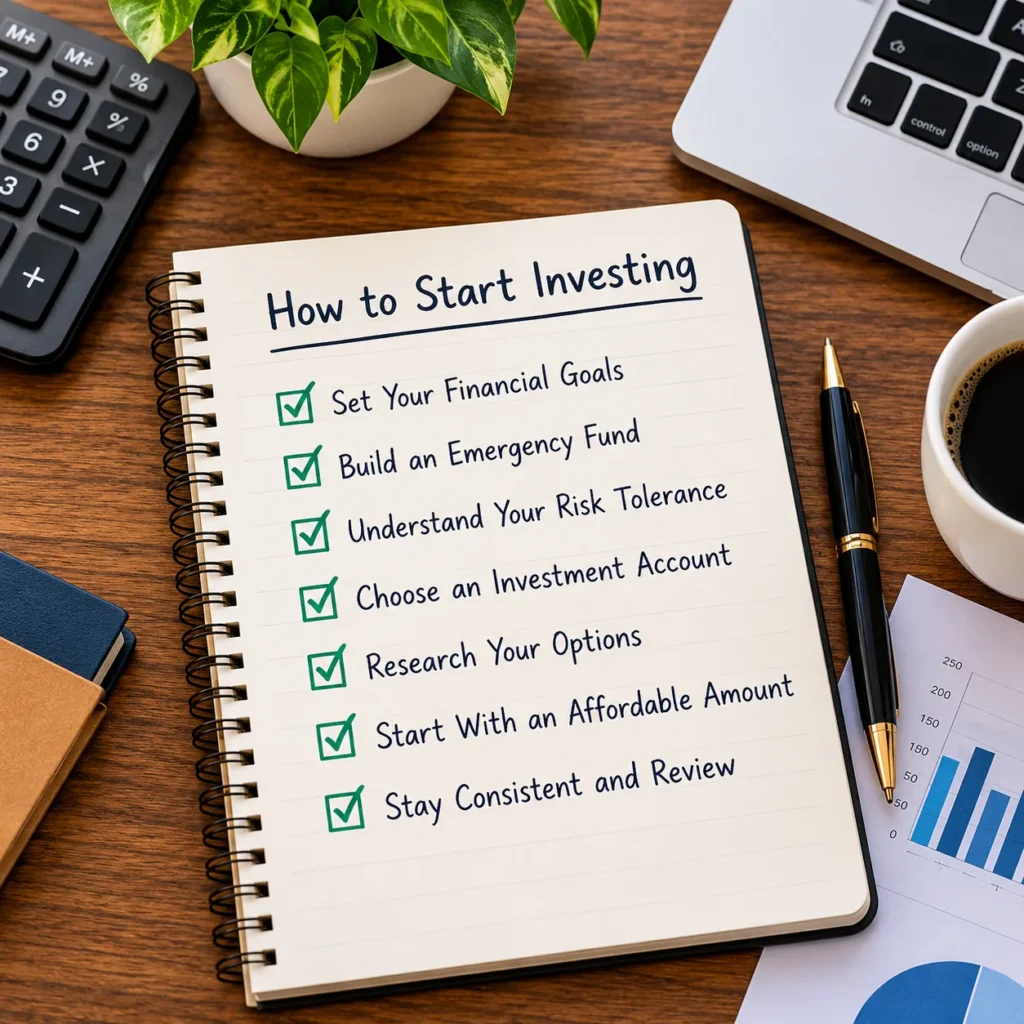
Starting your investment journey does not require knowing everything about the stock market. A clear plan can help you make more informed decisions.
Step 1: Set Your Financial Goals
Decide what you want your investments to help you achieve. Your goal might be retirement, a home purchase, education, or long-term wealth accumulation.
Your goals will influence your investment choices and time horizon.
Step 2: Build an Emergency Fund
Consider keeping accessible savings for unexpected expenses before committing substantial money to investments.
An emergency fund can reduce the likelihood that you will need to sell investments during a market downturn to cover an urgent expense.
Step 3: Understand Your Risk Tolerance
Evaluate how much loss you could financially and emotionally handle.
Money needed soon may be unsuitable for volatile investments, while long-term goals may allow a different investment approach.
Step 4: Choose an Investment Account
Depending on your country, eligibility, and goals, you may consider a standard brokerage account or a tax-advantaged retirement account.
In the United States, examples include traditional IRAs and Roth IRAs. Each has specific eligibility, contribution, withdrawal, and tax rules.
Compare account fees, available investments, and applicable restrictions before choosing an account.
Step 5: Research Your Investment Options
Learn about stocks, bonds, mutual funds, ETFs, and other assets before investing.
Review costs, diversification, historical performance, potential risks, and how each investment fits your goals. Remember that past performance does not guarantee future results.
Step 6: Start With an Affordable Amount
If you are financially prepared, consider starting with an amount that fits your budget.
Some investment platforms allow fractional-share purchases or offer funds with relatively low minimums, although availability varies.
Never invest money needed for essential expenses simply because you feel pressured to start quickly.
Step 7: Stay Consistent and Review Your Portfolio
Regular investing may help you build a long-term habit. Some investors contribute a fixed amount at regular intervals, a strategy commonly known as dollar-cost averaging.
This approach does not guarantee profits or prevent losses, but it can help reduce the pressure of trying to time the market.
Review your portfolio periodically to ensure it still aligns with your goals, financial situation, and risk tolerance.
Conclusion
Understanding what investing is and how it works is an important first step toward making informed financial decisions. From stocks and bonds to passive investing, dividend strategies, angel investing, and real estate, each approach offers different opportunities and risks. There is no single investment strategy that works for everyone, because financial goals, time horizons, and risk tolerance vary from person to person.
Beginners can build a stronger foundation by learning about different asset classes, maintaining emergency savings, understanding investment costs, and diversifying appropriately. It is also important to remember that investment returns are never guaranteed, and even carefully researched investments can lose value. Rather than chasing quick profits, focus on developing a realistic plan that suits your financial circumstances. With consistent learning, thoughtful research, and regular portfolio reviews, you can make better-informed decisions and work toward your long-term financial goals.
Frequently Asked Questions About Investing
Q1: What is investing, and how does it work?
A: Investing involves purchasing assets with the expectation of generating income or increasing their value over time. Returns depend on the investment's performance, costs, market conditions, and other factors. Losses are possible.
Q2: Can beginners start investing with little money?
A: Yes. Depending on the investment platform and product, beginners may be able to start with relatively small amounts. It is important to understand fees, investment risks, and financial goals before getting started.
Q3: Is passive investing better than active investing?
A: Neither strategy is universally better. Passive investing generally tracks a market index, while active investing attempts to outperform a benchmark through investment selection or timing. Costs, goals, risk tolerance, and investment performance all matter.
Q4: Is high-risk investing suitable for beginners?
A: High-risk investing can expose beginners to substantial losses. Before considering speculative investments, understand the risks, maintain appropriate financial reserves, and avoid investing money you cannot afford to lose.
Q5: How do dividends help investors?
A: Dividends can provide income or be reinvested to purchase additional shares. However, dividend payments are not guaranteed, and the value of the underlying investment can decline.
Q6: What is the safest way to start investing?
A: No investment is completely risk-free in every respect. Understanding your goals, maintaining emergency savings, diversifying appropriately, controlling costs, and avoiding investments you do not understand can help you manage risk.